
12 May Knit Your First Dishcloth: Easy & Free Patterns for Beginners
Welcome to the wonderful world of knitting! If you’re searching for the perfect first project, look no further than the humble yet mighty dishcloth. Knitting dishcloths is an incredibly rewarding way for beginners to dive into this craft. They’re quick, practical, use basic techniques, and best of all, you end up with something useful for your home or perfect for gifting. This guide will walk you through everything you need to know, from choosing yarn to finding fantastic, free knitting dishcloth patterns specifically designed for beginners. Let’s cast on and create something handmade!
Why Knit Dishcloths? The Perfect Beginner Project
You might wonder, “Why start with a dishcloth?” Well, these small squares pack a big punch for newbie knitters. Firstly, they are fast projects. Unlike a scarf or sweater that can take weeks, you can often finish a dishcloth in an evening or two. This quick turnaround provides instant gratification and boosts confidence, keeping you motivated to learn more. Secondly, they are incredibly practical. Everyone needs dishcloths! Making your own means you have a steady supply of durable, effective cleaning cloths.
Beyond speed and utility, dishcloths are fantastic skill builders. They typically use fundamental stitches like the knit stitch and purl stitch, allowing you to practice forming even stitches and controlling your tension without committing to a massive project. Many simple patterns introduce basic increases or decreases, gently expanding your skillset. Plus, since they’re meant for scrubbing dishes, perfection isn’t the goal! A few wonky stitches or uneven edges won’t matter – it will still clean just fine. This low-pressure aspect makes them ideal for learning without frustration. They’re also eco-friendly and economical. You can choose sustainable cotton yarn, and handmade dishcloths often last much longer than store-bought synthetic sponges, reducing waste. A single skein of cotton yarn can often yield multiple dishcloths, making it a budget-friendly craft. Lastly, knitted dishcloths make wonderful handmade gifts – think housewarmings, hostess gifts, or additions to gift baskets.
Getting Started: Tools & Materials for Your First Dishcloth
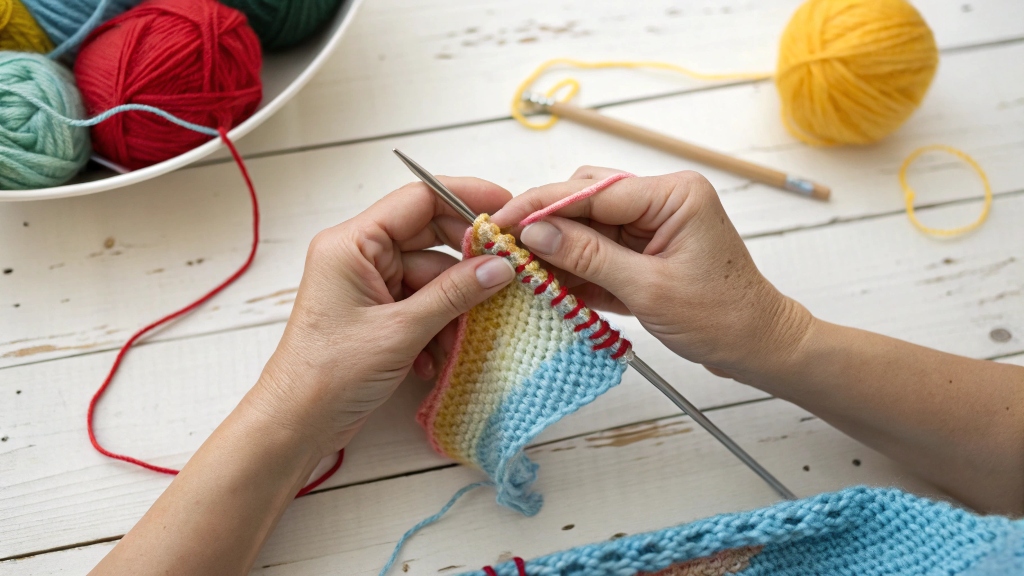
Before you dive into patterns, let’s gather the essentials. Thankfully, knitting dishcloths doesn’t require a huge investment.
Yarn: The absolute best choice for dishcloths is 100% cotton yarn. Why cotton? It’s highly absorbent (essential for wiping spills and washing dishes), durable enough to withstand scrubbing and repeated washing, and it dries relatively quickly. Avoid acrylic yarn, as it isn’t absorbent and can even melt if it touches a hot pan. Wool isn’t ideal either, as it doesn’t hold up well to constant wetness and can felt (shrink and mat) in hot water washes.
Look for worsted weight or DK (Double Knitting) weight cotton yarn. These are common weights, easy to handle for beginners, and readily available. Popular choices include Lily Sugar ‘n Cream, Peaches N Cream, Knit Picks Dishie, Lion Brand 24/7 Cotton, and Hobby Lobby I Love This Cotton. Many brands offer variegated or multi-colored options if you want to add visual interest without changing yarns. Mercerized cotton (like Lion Brand 24/7) has a slight sheen and is extra durable, while unmercerized cotton (like Sugar ‘n Cream) is often considered slightly more absorbent. Either works beautifully. You’ll typically only need one skein (around 50-70g or 90-100 yards) per dishcloth.
Knitting Needles: The needle size depends on your yarn weight and how tightly or loosely you knit. For worsted weight cotton, a US size 6, 7, or 8 (4.0mm, 4.5mm, or 5.0mm) knitting needle is usually recommended. Size 7 (4.5mm) is a great starting point. If you find your stitches are too tight, go up a size; if they’re too loose, go down a size. Straight needles are perfectly fine for dishcloths.
Other Notions:
- Scissors: For cutting the yarn.
- Tapestry Needle (or Yarn Needle): A large-eyed, blunt needle used to weave in the yarn ends when you finish.
- Stitch Counter (Optional): Helpful for keeping track of rows, especially in patterns with repeats.
- Tape Measure: To check the size of your finished dishcloth.
Basic Knitting Stitches for Dishcloths
Most beginner dishcloth patterns rely on just two fundamental stitches:
- The Knit Stitch (k): This is the most basic stitch and forms the foundation of garter stitch fabric (where every row is knitted). It creates a bumpy, reversible texture.
- The Purl Stitch (p): The reverse of the knit stitch. Combining knit and purl stitches creates different textures like stockinette stitch (smooth on one side, bumpy on the other) and seed/moss stitch (textured and reversible).
You’ll also need to know:
- Casting On (CO): Creating the initial stitches on your needle to start the project. The long-tail cast-on is a popular and sturdy method for beginners.
- Binding Off (BO) / Casting Off (CO): Securing the stitches at the end of the project to prevent unraveling.
Don’t worry if these sound complicated! Countless free video tutorials online demonstrate these techniques clearly. Search for “how to cast on knitting,” “how to knit stitch,” “how to purl stitch,” and “how to bind off knitting.”
Easy & Free Beginner Dishcloth Patterns (Concepts & Where to Find Them)
Ready to cast on? Here are concepts for some of the easiest and most popular free knitting dishcloth patterns for beginners. You can find full patterns incorporating these ideas on knitting websites, yarn brand sites (like Lion Brand, Yarnspirations, Knit Picks), platforms like Ravelry (a huge database of patterns), and knitting blogs (search for “Handy Little Me dishcloths,” “Nimble Needles dishcloth pattern,” “Nourish and Nestle dishcloths”).
-
The Absolute Easiest: Garter Stitch Dishcloth
- Concept: This uses only the knit stitch. You simply cast on your desired number of stitches (e.g., 30-40 stitches for a worsted weight yarn on size 7 needles) and knit every single row until the cloth is square (or your desired rectangle). Then, bind off.
- Why it’s great for beginners: Practices the knit stitch and tension control. Creates a squishy, textured, reversible fabric that doesn’t curl. It’s the perfect “first ever” knitting project.
-
The Classic Diagonal (Grandmother’s Favorite) Dishcloth
- Concept: This pattern starts with just a few stitches (often 4). You increase one stitch on nearly every row (usually using a ‘yarn over’ (yo) increase near the edge) until the side edge reaches your desired dishcloth width. Then, you begin decreasing one stitch on nearly every row (often using ‘knit two together’ (k2tog) decreases) until you’re back down to the starting number of stitches. Bind off.
- Why it’s great for beginners: Introduces basic increasing (yo) and decreasing (k2tog) in a simple, repetitive way. Creates a lovely diagonal texture and classic look. Many free versions exist online.
-
Textured Seed Stitch or Moss Stitch Dishcloth
- Concept: These stitches involve alternating knit and purl stitches.
- Seed Stitch: K1, P1 across the row. On the next row, you knit the purl stitches and purl the knit stitches (P1, K1).
- Moss Stitch: Often worked over a multiple of 2 or 4 stitches. A common version is (K1, P1) for two rows, then (P1, K1) for two rows, repeating these four rows. Double Moss stitch might be (K2, P2) for two rows, then (P2, K2) for two rows.
- Why it’s great for beginners: Practices switching between knit and purl stitches. Creates a beautiful, bumpy, textured fabric that lies flat and is great for scrubbing. It looks more complex than it is! Many patterns add a simple garter stitch border (knitting the first and last few stitches of every row).
-
Simple Stockinette Stitch with Border
- Concept: Stockinette stitch is created by knitting one row (the “right side” – RS) and purling the next row (the “wrong side” – WS). However, stockinette fabric curls dramatically on its own. To make a dishcloth, you must add a border on all four sides using a non-curling stitch like garter stitch or seed stitch (e.g., knit the first 3 and last 3 stitches of every row, and work the beginning and end rows entirely in garter stitch).
- Why it’s good practice: Helps solidify the difference between knit and purl rows and practice tension. The border teaches how to prevent curling.
Where to Find Full Free Patterns:
- Ravelry.com: Search filters allow you to find free, beginner-friendly dishcloth patterns using cotton yarn.
- Yarn Brand Websites: Lion Brand, Yarnspirations (home of Lily Sugar ‘n Cream, Bernat), Knit Picks often have free patterns.
- Knitting Blogs: Websites like Handy Little Me, Nimble Needles, Nourish and Nestle, Making it in the Mountains, The Spruce Crafts, and many others offer free patterns and tutorials.
- Pinterest: Search for “free knit dishcloth pattern beginner.”
Tips for Beginner Knitters Tackling Dishcloths
- Choose Light-Colored Yarn: It’s much easier to see your stitches with light or bright yarn than with dark colors like navy or black when you’re learning.
- Practice Swatching: Before starting, knit a small square (a swatch) to practice the stitches, check your tension (how tight or loose your stitches are), and ensure you like the fabric created with your chosen yarn and needles.
- Count Your Stitches: Get in the habit of counting your stitches at the end of each row, especially when increasing or decreasing, to catch mistakes early.
- Don’t Fear Frogging: “Frogging” means ripping out your stitches (rip-it, rip-it). Every knitter makes mistakes! Don’t be afraid to unravel your work back to where the error occurred and fix it. It’s part of the learning process.
- Use Lifelines (Optional): For slightly more complex patterns, you can thread a piece of contrasting scrap yarn through all the stitches on your needle every few rows. If you make a major mistake later, you can unravel back to the lifeline without losing all your work.
- Watch Videos: If written instructions are confusing, search for video tutorials of the specific stitch or technique. Seeing it done can make a huge difference.
- Relax Your Grip: Beginners often knit very tightly, which can make it hard to insert the needle and can strain your hands. Try to relax your hands and yarn tension.
- Be Patient: Learning takes time. Your first dishcloth might not be perfect, but it will be functional, and you’ll learn so much! Enjoy the process.
People Also Ask (FAQs)
Here are answers to some frequently asked questions about knitting dishcloths, especially for beginners:
What is the best yarn for knitting dishcloths?
100% cotton yarn is the best choice due to its absorbency, durability, and washability. Worsted weight is most common and easiest for beginners. Avoid acrylic and wool.
What size knitting needles are best for dishcloths?
For worsted weight cotton yarn, US size 6, 7, or 8 (4.0mm, 4.5mm, or 5.0mm) needles are typically recommended. Size 7 (4.5mm) is a popular starting point. Adjust based on your personal knitting tension.
How long does it take to knit a dishcloth?
For a beginner, a simple dishcloth might take a few hours, perhaps spread over a couple of evenings. Experienced knitters can often complete one in an hour or two. It depends on the pattern complexity, knitting speed, and size.
Can I wash knitted dishcloths?
Absolutely! That’s the point. Dishcloths made from 100% cotton yarn are machine washable and dryable. Wash them with towels or other kitchen linens. They get softer and often more absorbent with use and washing.
What’s the easiest knitting stitch for a beginner dishcloth?
The Garter Stitch (knitting every stitch of every row) is the absolute easiest. It creates a reversible, textured fabric that doesn’t curl. The classic diagonal pattern is also very popular for beginners as it introduces simple increases and decreases.
How many stitches should I cast on for a dishcloth?
This depends on your yarn weight, needle size, and desired width. For a worsted weight yarn on US 7 needles, casting on around 30-40 stitches often results in a standard dishcloth size (around 8-10 inches wide). Patterns will specify the cast-on number. For diagonal patterns, you start with very few (like 4).
Do I need to block my knitted dishcloth?
Blocking (wetting the finished item and pinning it into shape to dry) isn’t strictly necessary for dishcloths like it is for garments or lace. However, a quick wash and tumble dry (or laying flat to dry) after knitting will even out the stitches and give it a nice finish.
Read More Also: Why School Meals Lack Nutritional Balance
Conclusion: Your Knitting Journey Begins!
Knitting your first dishcloth is more than just making a cleaning tool; it’s embarking on a creative journey. It’s about the satisfaction of learning a new skill, the rhythm of the needles, and the joy of creating something tangible and useful with your own two hands. These small, practical projects offer the perfect entry point into the vast and rewarding world of knitting.
Don’t be intimidated by the needles and yarn. Choose a simple pattern, embrace the learning process (mistakes and all!), and enjoy the feeling of accomplishment as your dishcloth takes shape. With readily available free patterns and affordable cotton yarn, there’s never been a better time to start. So grab your supplies, find a cozy corner, and cast on – your stack of beautiful, handmade dishcloths awaits! Happy knitting!
No Comments